English| EUR
Suggested for you
More currencies
Choose a language
Double decker buses dominate Toronto's sightseeing circuit, carrying thousands of visitors daily through the downtown core and waterfront districts. The question of their safety arises from their height, open upper decks, and unfamiliar design for North American riders. This guide examines the engineering, regulatory oversight, and operational track record that governs these vehicles.
Quick answer
Are double decker buses safe? Yes—modern double decker sightseeing buses maintain an exceptional safety record in Toronto, with no passenger fatalities recorded in commercial hop-on hop-off operations. These vehicles meet Transport Canada standards for stability, are built with low centers of gravity to prevent rollover, and operate under strict route planning that accounts for overhead clearances and turning radius. The open upper deck includes safety rails, and operators enforce capacity limits to maintain balance.
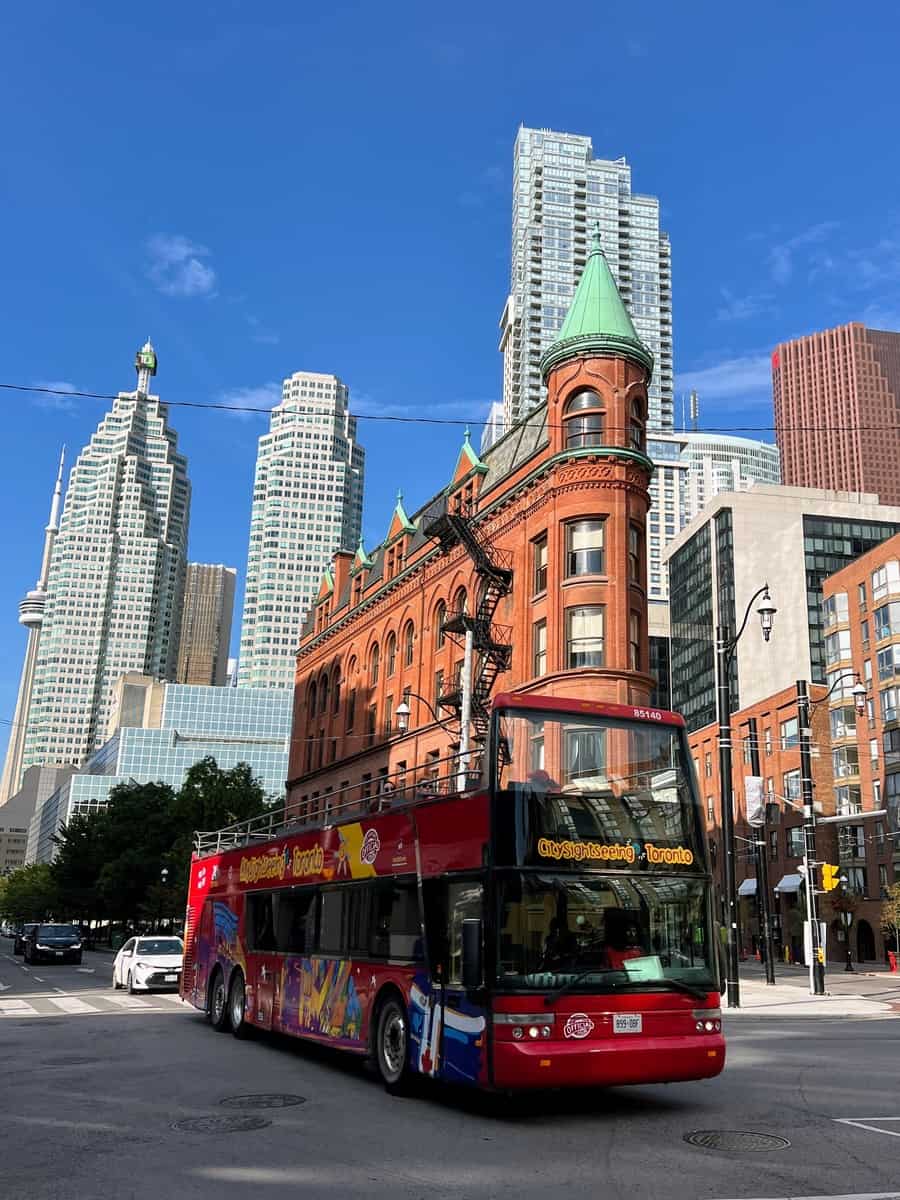
The double decker bus operating on Toronto's hop-on hop-off circuit weighs approximately 12 tonnes and stands 4.3 meters tall, yet its center of gravity sits below the lower deck floor, a deliberate engineering choice that makes the vehicle more stable than its silhouette suggests. Manufacturers achieve this through chassis design that places the heaviest components—engine, transmission, fuel tanks—at the lowest possible point, counteracting the mass of passengers seated above. Transport Canada classifies these buses as commercial passenger vehicles, subjecting them to the same mechanical inspections, driver certification requirements, and insurance thresholds as motor coaches. Toronto's sightseeing operators run daily pre-trip inspections covering brakes, steering, lights, and emergency exits, with third-party safety audits conducted quarterly. The route itself is planned to avoid low bridges, narrow turns, and grades that exceed the vehicle's rated incline, removing environmental hazards before they reach the driver's decision-making. The open upper deck raises concern about ejection risk, but the design mitigates this through continuous perimeter railings, seat positioning that keeps passengers' center of mass inboard, and a maximum speed of 50 km/h on city streets. Operators do not permit standing passengers on the upper level while the bus is in motion, and the stairwell is cordoned during acceleration and braking. Weather plays a role—tours pause during high wind advisories or freezing rain, conditions that compromise visibility and traction regardless of vehicle type. Statistical context matters. Toronto's hop-on hop-off fleet has operated since the early 2000s without a rollover incident, and the handful of insurance claims filed over two decades involve minor collisions at low speed, predominantly in parking maneuvers. The risk profile for a passenger aboard a double decker sightseeing bus in Toronto is materially lower than riding a standard transit bus in mixed traffic, because the route, speed, and driver training are all optimized for a single purpose. The vehicle's height is its most scrutinized feature, but the engineering and regulatory framework surrounding it render the double decker bus safe for Toronto visitors.
“The center of gravity sits below the lower deck floor, making the vehicle more stable than its silhouette suggests.”
The height and structure of double-decker buses often lead to concerns regarding their stability and roadworthiness. These misconceptions typically stem from the vehicle's visual profile rather than its actual engineering.
MythDouble-decker buses are prone to tipping over.
FactModern double-decker buses undergo rigorous tilt-table testing to ensure they remain stable even at extreme angles, far exceeding normal operating conditions.
MythThe top deck is less safe during a collision.
FactThe chassis of these vehicles is engineered with a low center of gravity and reinforced steel frames to prioritize passenger stability and structural integrity on all levels.
MythDouble-decker buses cannot navigate city streets safely.
FactOperators maintain strict adherence to height clearance regulations and follow pre-planned routes that account for the specific dimensions and turning radii of these specialized vehicles.
Double decker buses in Toronto operate under rigorous safety frameworks designed to manage vehicle stability and passenger security in urban environments. These vehicles undergo strict engineering assessments to ensure they meet municipal transit safety standards.
Toronto double decker buses are engineered with specific height clearances in mind to safely navigate city infrastructure and underpasses. Regular route mapping ensures these buses only travel on designated streets capable of accommodating their dimensions.
Modern double decker buses utilize specialized chassis designs to maintain a low center of gravity. This engineering approach significantly reduces the risk of tipping during sharp turns or emergency maneuvers.
Manufacturers subject double decker models to tilt table testing to verify stability limits. These tests confirm that the buses remain stable even when fully loaded to maximum passenger capacity.
Operators perform daily and periodic vehicle inspections to monitor braking systems, steering components, and tire integrity. These preventative maintenance protocols ensure every bus meets safety requirements before entering service each day.
Many modern double decker buses are equipped with electronic stability control systems that automatically adjust engine torque and braking. This technology assists operators in maintaining control during adverse weather conditions or sudden steering inputs.
Operators must undergo specialized training programs focused on the unique handling characteristics of double decker vehicles. This training emphasizes defensive driving techniques and awareness of the bus's overhead clearance at all times.
Safe travel on a double decker bus depends on passenger behavior as much as vehicle design. Follow these guidelines to protect yourself and others during your tour.
The hop-on hop-off double decker bus tours operate on a consistent daily schedule throughout the week. Visitors are encouraged to plan their arrival within the designated window to ensure enough time to complete the full bus loop.
The departure point for City Sightseeing Toronto tours is located at Sankofa Square, Toronto, ON M5B 2R8. This central location is well-connected by public transit and is easily accessible from major downtown intersections.
Line 1 Yonge-University to Dundas Station
Walk east from Yonge Street to Sankofa Square
Parking available in nearby paid garages
For the best experience, aim to arrive between 09:00–16:00. This window ensures full daylight for your tour and provides sufficient time to complete the full bus loop.
Everything you need to know about are double decker buses safe
Yes, are double decker buses safe and operated by professional drivers who follow strict city transit regulations to ensure passenger security. These vehicles are regularly inspected to maintain high standards for public transportation on city streets.
Safety protocols include mandatory seatbelts, clear signage, and speed limiters that govern how fast the vehicle can travel. Drivers also undergo specialized training to navigate urban traffic while managing the height and weight of the double decker frame.
Many families find that are double decker buses safe for children, provided that younger passengers remain seated while the vehicle is in motion. It is recommended that adults supervise children closely, especially when climbing or descending the staircase to the upper level.
Operators prioritize safety by adhering to rigorous maintenance schedules and conducting pre-trip inspections of all mechanical systems. Staff members are also trained to assist passengers with boarding and to ensure that gangways remain clear throughout the journey.
While are double decker buses safe in most conditions, the open-top nature of many units means they are best enjoyed during clear weather. If heavy rain or high winds occur, passengers are typically moved to the covered lower level for their protection.
You can book your tour online through the official site, which helps ensure you have a reserved spot for your preferred date. Starting at 49.44 CAD, these tickets provide convenient hop-on hop-off access for exploring various Toronto landmarks.
If you are concerned about motion sensitivity, the lower level of the vehicle offers a more stable seating environment. Sitting toward the front of the bus can also help reduce the sensation of movement during the tour.